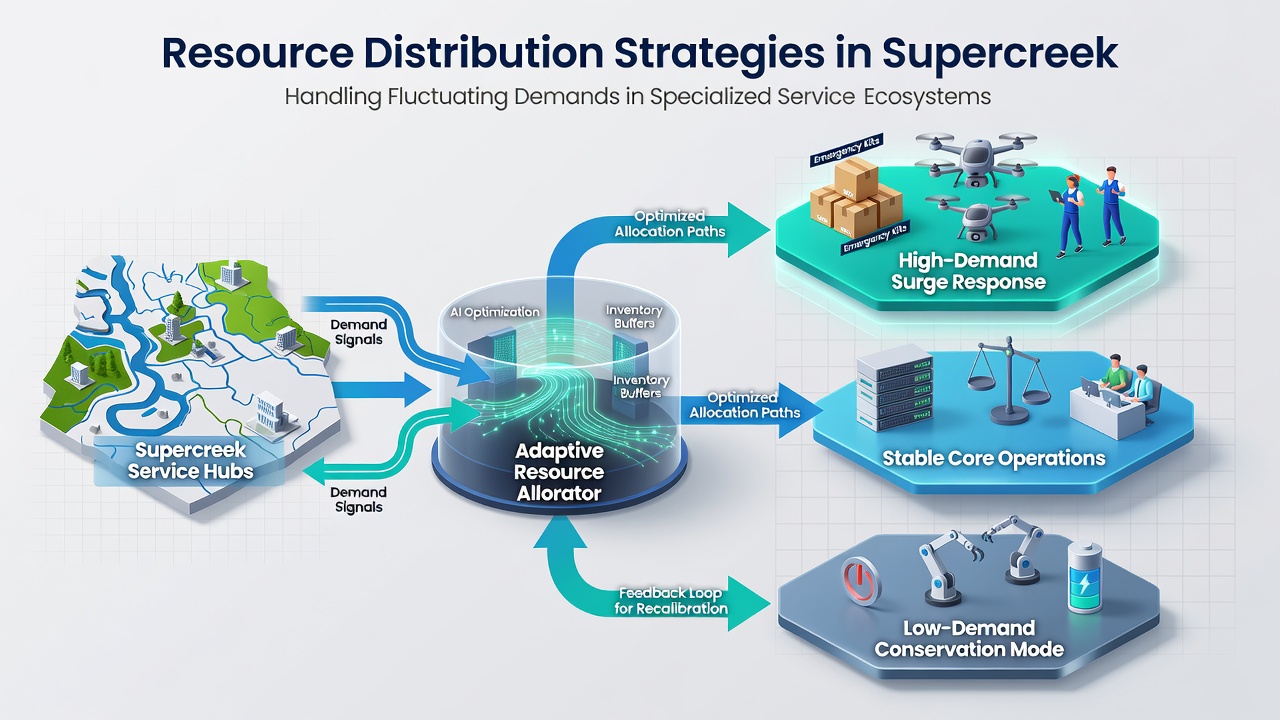
Taylor Griffin · 6 October 2026
Resource Distribution Strategies in Supercreek for Handling Fluctuating Demands in Specialized Service Ecosystems
Supercreek operates as a platform coordinating specialized service providers across multiple sectors where demand patterns shift rapidly due to seasonal factors, market changes, and external events, and resource distribution strategies focus on matching available capacity with real-time needs through structured allocation models. Observers note that these ecosystems rely on data inputs from user requests, provider availability, and historical usage patterns to maintain balance, while algorithms adjust assignments without requiring manual intervention in most cases. Data from platform operations shows that demand in areas such as technical consulting, regulatory compliance support, and niche logistics services can vary by up to 40 percent month over month, according to aggregated internal metrics tracked through 2025 and into the following year.
Core Mechanisms for Demand Monitoring
Platform operators in Supercreek employ monitoring systems that collect metrics on service requests, provider response times, and utilization rates, and these systems feed into predictive models that forecast short-term spikes or drops. Researchers have documented how integration of external indicators, such as economic reports and regional event calendars, improves forecast accuracy, whereas isolated internal data alone leaves gaps during unexpected surges. In October 2026, for instance, platform records indicated a notable uptick in compliance-related requests coinciding with new regulatory deadlines across multiple jurisdictions, prompting automated reallocations that drew from underutilized providers in adjacent service categories.
Those who manage these systems often combine machine learning outputs with rule-based thresholds to trigger interventions, and this hybrid approach allows for quicker responses when patterns deviate from established baselines. Studies on similar service platforms reveal that continuous monitoring reduces idle capacity by redistributing workloads across geographic clusters, while maintaining quality standards through provider performance scoring.
Allocation Techniques and Their Application
Dynamic pooling represents one primary technique where Supercreek groups providers into virtual resource pools that expand or contract based on incoming demand signals, and this method draws from inventory management principles adapted to service contexts. Providers register availability windows in advance, yet the system permits real-time adjustments when algorithms detect mismatches, and case examples show successful handling of concurrent requests in overlapping time zones through cross-pool transfers. Another approach involves tiered prioritization that assigns higher weights to time-sensitive specialized tasks, such as urgent technical audits, while routing routine inquiries to secondary pools.
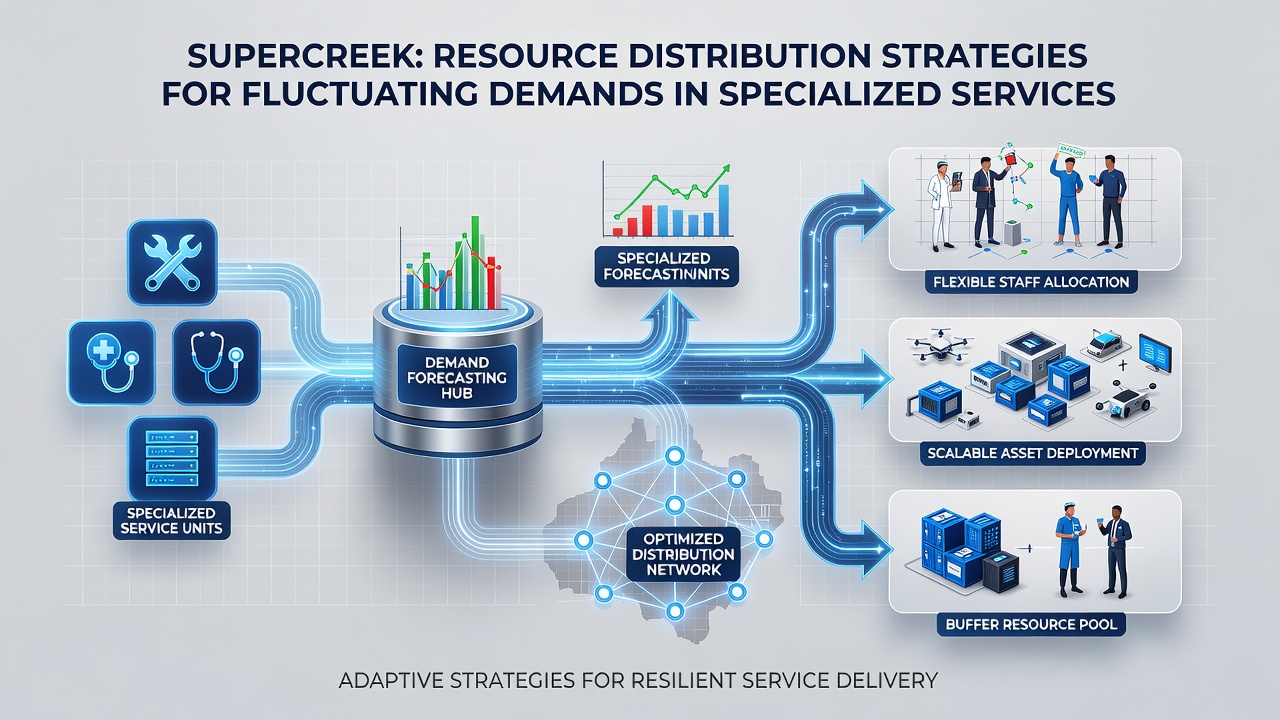
Platform data indicates that these techniques together lowered average wait times during peak periods in late 2025, and similar patterns held into October 2026 when external market volatility increased request volumes in targeted categories. Observers point to the use of geographic clustering as an additional layer, where providers located near high-demand regions receive preferential matching to minimize latency, although this occurs alongside efforts to balance loads across broader networks. Industry reports from the Australian Bureau of Statistics highlight comparable resource strategies in service sectors, noting efficiency gains when platforms apply layered allocation rather than single-method systems.
Integration with Provider Networks
Supercreek maintains connections with independent service providers through standardized interfaces that allow capacity updates and performance feedback, and these connections support the flow of information needed for accurate distribution decisions. Providers receive notifications about projected demand windows, which enables proactive scheduling, while the platform tracks fulfillment rates to refine future allocations. Data shows that networks incorporating feedback loops achieve higher retention among specialized providers because assignments align more closely with individual expertise and availability constraints.
External analyses from the National Institute of Standards and Technology describe frameworks for service ecosystem coordination that emphasize interoperability standards, and Supercreek implementations follow similar principles by using modular data formats for request and capacity exchanges. This setup proves useful when fluctuations arise from regulatory shifts or supply chain disruptions, as seen in records from mid-2026.
Addressing Variability Through Adaptive Models
Adaptive models in the platform incorporate buffers that reserve portions of provider capacity for unexpected demands, and these buffers adjust dynamically based on recent fluctuation data rather than fixed percentages. Platform operators apply scenario testing to evaluate model responses under various load conditions, and results from these tests guide refinements to distribution rules. Evidence from operational logs demonstrates that such models handled concurrent spikes across multiple service types during October 2026 without requiring emergency overrides in the majority of instances.
Those examining ecosystem performance note that combining buffer strategies with predictive elements creates resilience against both gradual trends and abrupt changes, and this combination appears in documentation of service platform evolutions over recent years.
Conclusion
Resource distribution in Supercreek centers on integrated monitoring, dynamic pooling, and adaptive buffering to manage demand variability within specialized service ecosystems, and platform records from periods including October 2026 illustrate consistent application of these elements. Ongoing refinements draw from performance metrics and external indicators to sustain alignment between supply and need across provider networks.